
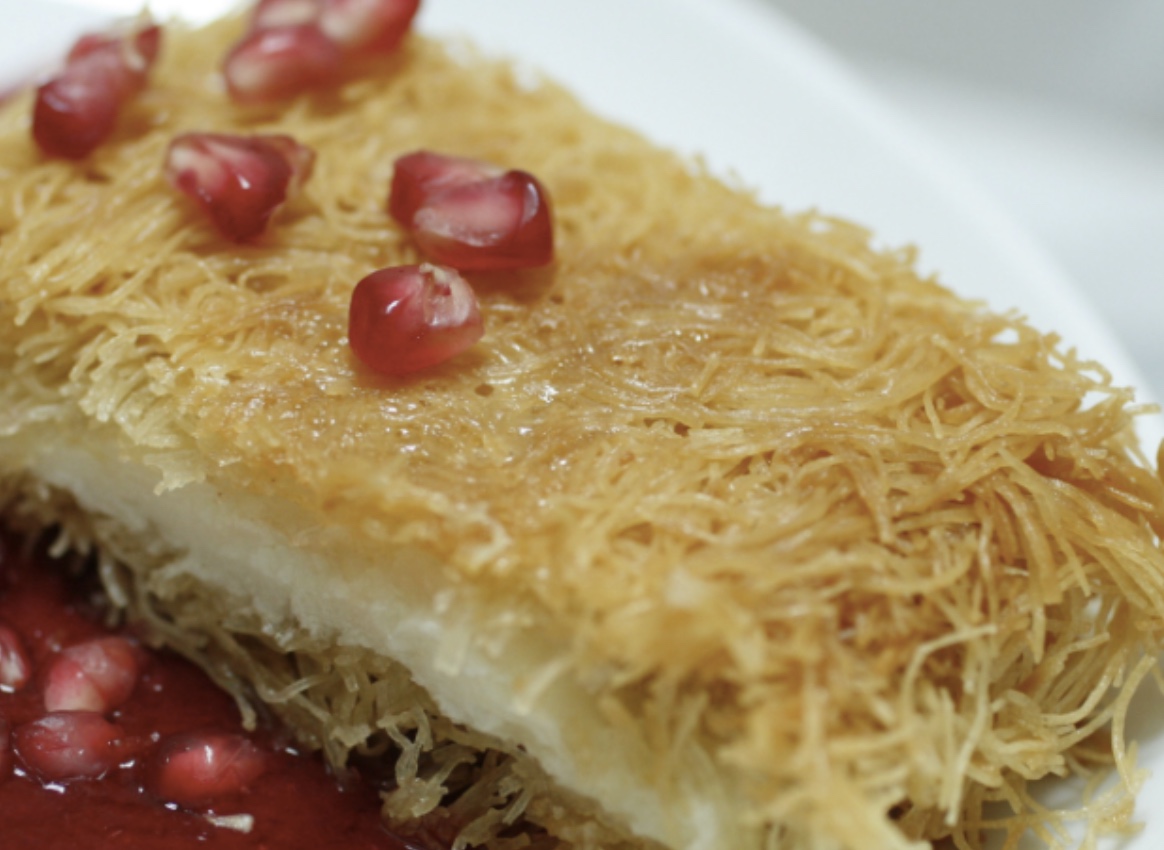
Stringy bits of fried dough with nuts and honey: YUM!
Ramadan is a month of fasting for Muslims around the world. But also key during this time is the breakfast (the breaking of the fast) called the Iftar meal. Every evening, for a month, there is a flurry of activity, so that everyone can get to the place where they will have this break-the-fast meal: at home, at a restaurant, near the sea, with family or friends. These meals are usually started with dates and a glass of water, accompanied by a prayer.
Then it is time to dig into the food:
These meals are usually quite significant:
* special drinks
* soup
* meat or chicken
* and lots of bread, pasta, rice
But many people’s favourites are the desserts after the meal. And the queen of Ramadan desserts has to be:
Kunafa
This is a glorious pastry, with several layers, types and sizes, consumed in vast quantities during ramadan. Where did this pastry originate from? Some call it a Palestinian dessert from the 10th century. Others say it goes back to the days of Mesopotamia. But whatever the origins, in Egypt, particularly during Ramadan, it is enjoyed by all.
Traditional Kunafa
1. The basis of the kunafa is a long, thing, noodle-type pastry (flour, water, oil), which looks rather like thin spaghetti. It is prepared in local bakeries, on a very large, round, rotating griddle. When it is finished, it looks a bit like a pale bird’s nest, often referred to as angel hair. It is gathered up in large armfuls off the griddle by the baker. If eaten at this point, it is rather tasteless!
2. This angel hair is then usually soaked in syrup (water, sugar and rose-water), with a dash of orange colouring. It is then divided into layers, or shapes that are required.
3. In between the layers, in the middle, is usually a light, unsalted white cheese or cream filling (or a combination of the 2). Baking then gives it a lovely brown and crunchy taste.
4. Some nuts (usually pistachio) are then added on the top
Some forms of Kunafa are sold warm and delicious. Others are just as tasty eaten at room temperature or cold.
Modern Kunafa
Over recent years, I have noticed, in many of the new and exciting restaurants and coffee shops that have popped up all over Egypt, a modernization of the kunafa
1. The size: no longer is it made only in the traditional, vast, round metal containers. There are now mini kunafa. These can look like tiny birds nests, and in the middle nests is a lovely pistachios or almond. There are also round family sized layered Kunafa, looking more like a cake.
2. The filling: now gone is the basic cheesy filling. Now available is nutella, custard, and even red velvet. My favourite is the mango Kunafa.
3. A few days ago, I noticed a Cronafa. This is a cross between a croissant and a Kunafa! It is a mini croissant stuffed with creamy-cheese, rolled in orange vermicelli Kunafa pastry, topped with nuts. Or you could have Nutella or mango!
But whichever kind attracts you, the traditional or the modern, do go ahead and have a piece. Or better still, get invited to an Iftar meal with a local family, and go and buy a lovely, sweet, creamy Kunafa. Watch the eyes of everyone at the table begin to shine with joy, as it shared out at the end of the Iftar meal.