
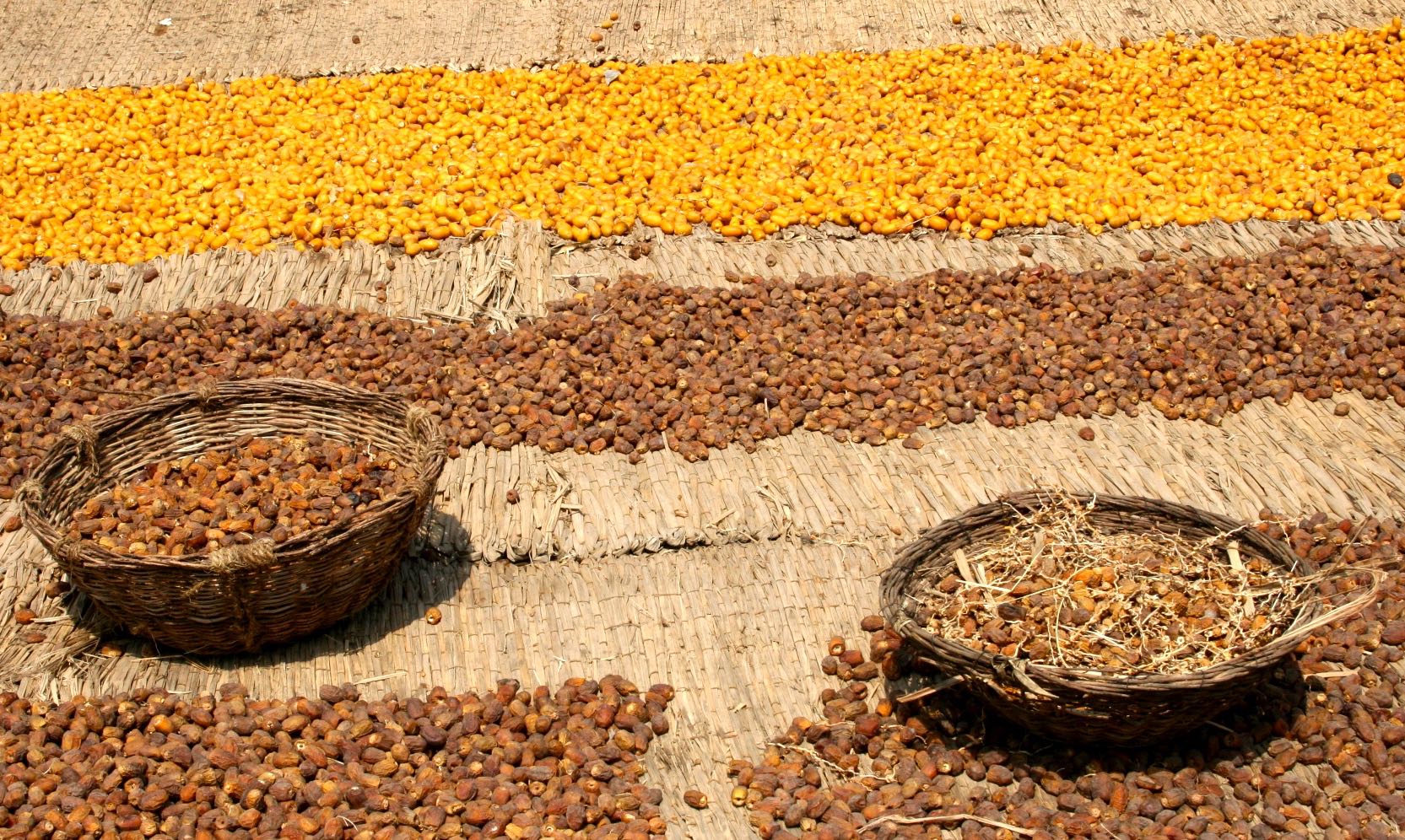
The blessed fruit of the palm tree
3 types of Dates
These types are different in size, colour, taste and price!
Sikodi: These are long and soft, brown and yellow in colour. They are prevalent during the month of Ramadan, where eating dates is the way to break the daily fast.
Bertimoda: These are small and yellow. They are known for their energy (glucose) and are often mixed with ghee to provide a buttery-sugary energy boost. They are the cheapest of the 3 dates.
Agandera: These are the most expensive, and are chocolate brown in colour. They are used for eating and are considered the best tasting.
The Date Cycle
Planting usually takes place in January (towards the end of winter). This can either be by:
* seeds – which is considered more risky, as you cannot be sure which kind of the 3 dates you are planting, nor whether it is male or female
* baby tree – which usually grows out of the mother tree. This is the safer and quicker route as it is established, you know what kind of date it is, and what sex.
The seed will take 3 months to begin to grow leaves, and almost 3 years to bear fruit.
The adult tree flowers in January, and is harvested in August. Usually a good adult tree will produce around 100kgs of dates in a year. After harvest the female trees will be pruned, in preparation for the following cycle. The leaves in which the fruit has ‘slept’ will be cut off, making room for the newer, fresher stronger leaves to do the job of holding the fruit the following year.
Male or Female?
There is a big difference between the male and female trees:
Female: they are wider, stronger, thicker and longer than their male counterparts. They are the ones that produce and bear the fruit.
Male: the male tree produces the pollen which will fertilise all the female trees within wind distance! Usually there is only a need for 1 male tree for every 4 or 5 female trees. Pollination is usually by wind (January/February being the windy time) but some farmers prefer to do manual pollination, harvesting the pollen from the male trees and placing it carefully in the female trees. The male trees do not produce any fruit.
Uses for dates
* eating (fresh!)
* jam (boiled and bottled)
* glucose (mixed with ghee)
* dried (and then crushed and used in cakes: agwa)
Each piece of the date palm tree has some benefit for the people:
* leaves: basket, carpets, roofing, hats, toys
* branches: brooms
* sisal: ropes, buckets, donkey bags or blankets
* branch spine: furniture
* seeds: crushed and used as kohl for the eyes!
Money, Money, Money
In the former times, dates were literally worth their weight in gold and even used as currency. There was a standard utensil used for measurement of dates. Dates could be used to barter for trading in the market or with neighbors. Dates were also used to pay off any outstanding credit that one might have at the local merchant. Dates were a sign of blessing, and in harvest time as the men were up the trees, throwing the dates down to the ladies below one could often hear lovely songs of praise and happiness being sung.