
A well-known artist
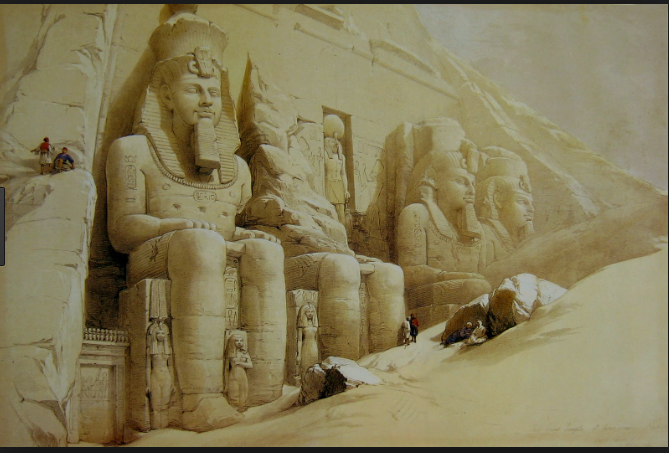
As you wander around Egypt, at bookshops, gift shops, stationary shops, one begins to notice a specific kind of artwork that appears in books and on postcards. Many of these are by the Scottish artist David Roberts, who is well-known for his prolific series of detailed lithograph prints from Egypt and the Near East. These he produced from sketches made on long tours of the region. He is an interesting man, whose art is still popular, even 150 years later.
David was born in 1796 near Edinburgh, Scotland, to a humble family of craftsmen: his father was a shoemaker. But despite such lowly beginnings, he became one of the most acclaimed landscape painters of the 19th century.
DRAWING
His talent for drawing became evident at an early age, when he was so inspired by the circus that he filled the kitchen wall with a procession of animals and people, with surprising skill for one so young. His parents encouraged him to develop this ability and skill, though sadly, coming from a poor family, he was not able to go to school. He was largely self-taught, and had to push through the social barriers of the day, which took decaces!
APPRENTICESHIP
At the age of 10, he was apprenticed to a house painter/decorator for 7 years. It was here that he learnt to paint using various mediums.
1815 He got a position as a foreman for a re-decorating project of a Palace.
1816 THE CIRCUS:
He began his career as a painter painting scenery and designing stage sets for a circus (he was almost 20 years old at the time). At this time he travelled with the circus, on a tour of England. He had to paint the stage designs and create the sets and also take on several minor stage roles during this time. When he had free time, he would go out into the surrounding areas and paint and sketch what he saw.
STAGE SCENERY PAINTER
He then developed his theatre experience by working in a number of theatres, and finally entered into the Theatre Royal (Edinburgh) and 1823 Drury Lane Theatre (London.) From here, his work as a scene painter attracted a variety of comments and criticism! But his true heart and love of landscape painting began to evolve when he started oil painting.
1824 He went on a trip to Europe, and as he travelled, sketched monuments and cathedrals with breathtaking detail. On his return home, he turned these sketches into ‘romantic travel paintings’, which were very much the fashion of the time. He was able to sell many of these.
1825 He worked for the Covent Garden theatre.
1827 The New Royal Scottish Academy did a showing of some of his work
By 1829 he was a full time artist and his own unique style had become apparent.
PRESIDENT OF SBA (Society of British Artists)
In 1831 he became the president of this society
1832 He began his travels in Spain and Tangiers
TOUR TO EGYPT (and the Holy Land)
In 1838 he left for Egypt (a dream of his since childhood), and had an extraordinary tour that saw him traveling the length and breadth of Egypt. As he travelled, he began to draw: monuments, architecture and people. Initially sketches of each site, and then from these sketches he created his now world famous lithographs. He aimed to sell these as Egypt was quite ‘the vogue destination’ at this time, and no-one else had painted the main sites of the area.
Interestingly his deepest desire was to visit was the site of Rameses 2nd in the heart of Nubia. He made a detailed sketch of this, and indeed every site and monument in the Nubia area. The detailed documentation of these sites in Nubia became particularly valuable, especially with respect to the Nubian temples, after the construction of the Great Dam of Aswan in 1971 (The High Dam as it is known.) This dam caused the flooding of a number of temple sites, and they had to be taken apart and carefully reassembled, sometimes many kilometres away from their original locations. His attention to minute detail was a help in the reconstruction.
When he finally reached Cairo, he already had over 100 sketches and paintings. He remained in Cairo for 6 weeks, and during this time he was permitted to enter a mosque and draw the interior. He was the first foreigner ever to be allowed to do this.
He devoted a great part of his attention to the masterpieces of Islamic architecture.
STYLE
Once he returned home, David Roberts used the numerous sketches he had made on each site, and his incredible memory. These were gradually transformed into prints which were then published, (by Francis Moon) using a method called ‘Lithography’, which required the complex task of engraving plates for each picture. Sometimes he would then hand paint additional colour onto the prints.
PUBLISHED
His tour to Egypt was published in London between 1842 and 1849. Egypt and the Holy Land took up 6 volumes (248 lithographs), the first 3 volumes were of Egypt and Nubia.
It showed a picture-story of his unforgettable journey along the Nile Valley and across the Sinai Peninsular and established him as one of the finest artists of his time, earning him the fame his work still produces today.